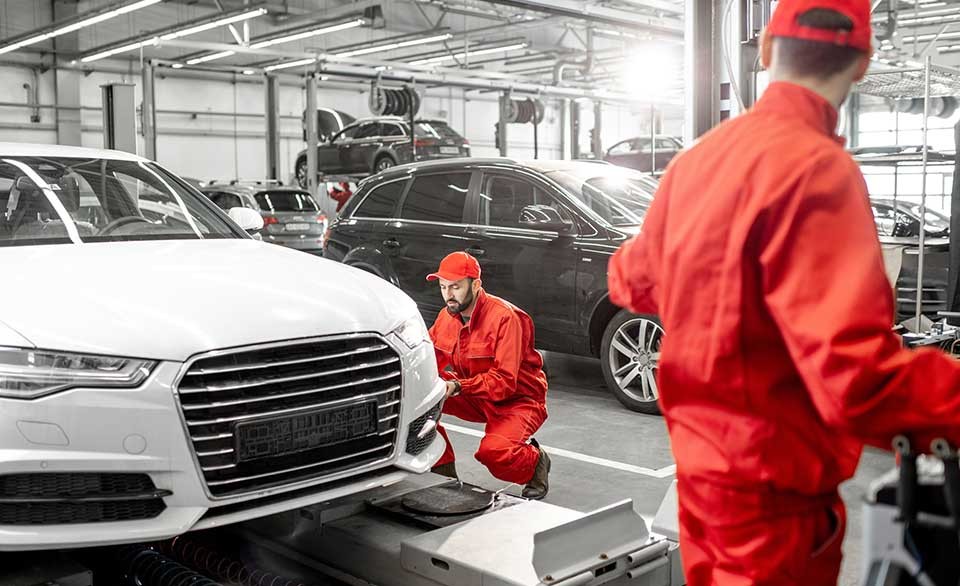
Picture a routine roadside check outside Rome. Your documents are in order, your insurance is paid, and then the officer looks at one date on your registration document and tells you the inspection expired last month. Nobody reminded you, there was no sticker on the windshield, and the deadline had no grace period.
If you come from the UK, Germany or a US state with a periodic safety test, the idea is familiar. Italy's version is called the revisione, and it works on its own timetable, with its own paperwork and a few rules that catch newcomers out, especially when the car was first registered abroad.
The revisione is simple once you know three things: when it is due, where to book it and what the inspector checks. This guide covers all three, along with the 2026 costs, what happens if you fail or skip it, and what changes for expats with imported cars.
Revisione at a Glance
- First inspection: 4 years after the car's first registration, then every 2 years.
- Deadline: the end of the due month, with no grace period.
- Cost: €79.02 at an authorized private center, or €45 plus a small payment fee at the Motorizzazione.
- Fine for an expired inspection: from €173 to €694, doubled if the violation is repeated.
- Status check: free, online, by license plate.
What Is the Revisione and Who Needs It?
The revisione is Italy's mandatory periodic technical inspection, set out in article 80 of the Highway Code (Codice della Strada). It checks that a vehicle is roadworthy and that its emissions are within the limits. It applies to every vehicle registered in Italy, and the schedule depends on the type of vehicle.
The 4-then-2 schedule covers passenger cars, motorhomes in the M1 category, vans and light commercial vehicles up to 3.5 tonnes, motorcycles, mopeds and light trailers. Taxis, chauffeured hire cars (NCC), buses, ambulances and vehicles above 3.5 tonnes are inspected every year. For an expat with a private car, the rule you need is the first one.
The revisione is separate from your insurance and from the annual road tax (bollo). Each has its own deadline, and paying one does not cover the others.
How Often Do You Need the Revisione?
The 4 + 2 rule
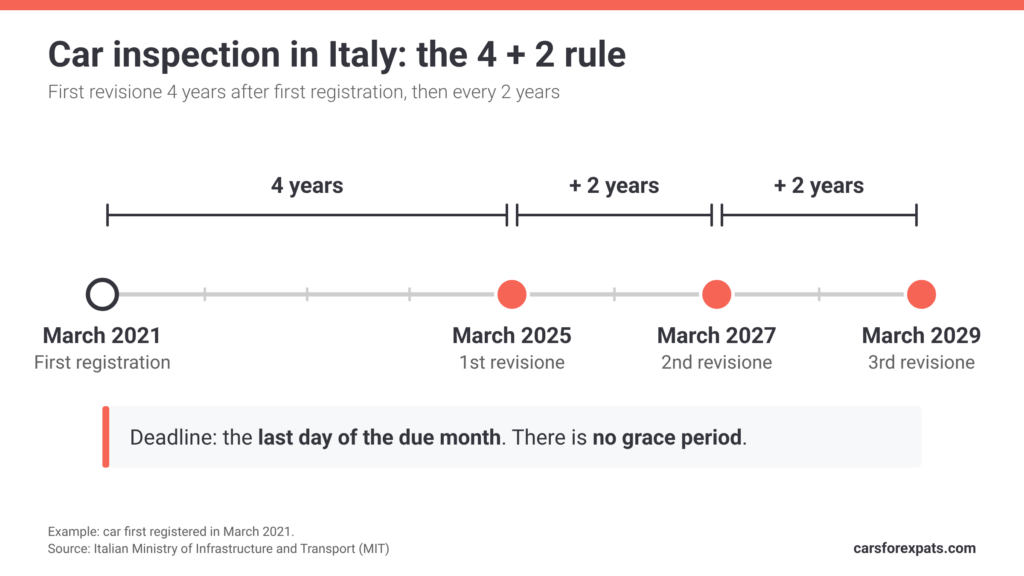
The first revisione is due 4 years after the car's first registration, within the month in which the registration document was issued. After that, it is due every 2 years, within the month that matches your last inspection.
What counts is the month, not the day. A car first registered in March 2021 must be inspected by the end of March 2025, then by the end of March 2027 and March 2029. The last day of the month is the real deadline, and there is no tolerance after it.
If you inspect the car much earlier than needed, your next two-year period starts from that earlier date. Booking a few weeks ahead is sensible. Booking many months ahead only shortens your cycle.
How to check your due date
- Look at your registration document (carta di circolazione), where inspections are recorded.
- Enter your license plate in the free inspection check on the Italian government's Portale dell'Automobilista.
- Register on the portal with SPID, Italy's digital identity, if you want expiry reminders by email.
Italy does not use a windshield sticker. The record lives on the registration document and in the national database, which police can check during a stop.
Foreign-Plated and Imported Cars: What Changes for Expats
This is where most expats get confused, because the answer depends on which plates the car carries.
Cars still on foreign plates. Italian inspection centers generally work only on vehicles registered in Italy. A car on foreign plates does not fit into the Italian system, and residents are expected to register it in Italy within three months of obtaining residency. Our guide to vehicle registration in Italy explains how that process works.
Cars re-registered in Italy. For the first Italian revisione, the starting point is generally the car's first registration in its country of origin, not the date it received Italian plates. A car first registered in Germany in 2020 and re-registered in Italy in 2021 would need its first Italian inspection in 2024 and the next in 2026. If the foreign inspection is recognized, the Italian deadline may instead follow the date of that inspection.
Check three dates on your Italian registration document: the original first registration, the Italian registration and the last inspection. Then confirm the due date on the Portale dell'Automobilista before you plan anything. If the dates do not add up, ask before the deadline passes, not after.
What Does the Revisione Include?
The inspector checks the identity of the vehicle first, comparing the plate and chassis number with your documents. The car then goes onto the test line, where the main systems are checked:
- Brakes, including braking efficiency on rollers
- Steering and suspension
- Tires, wheels and visible wear
- Lights, indicators and signaling devices
- Exhaust emissions
- Seat belts, horn and other safety equipment
- Dashboard warning lights, increasingly read through the car's diagnostic port
The revisione is a legal safety and emissions check. It does not assess the general condition of the engine or tell you how much life your car has left.
How Much Does the Revisione Cost in Italy (2026)?
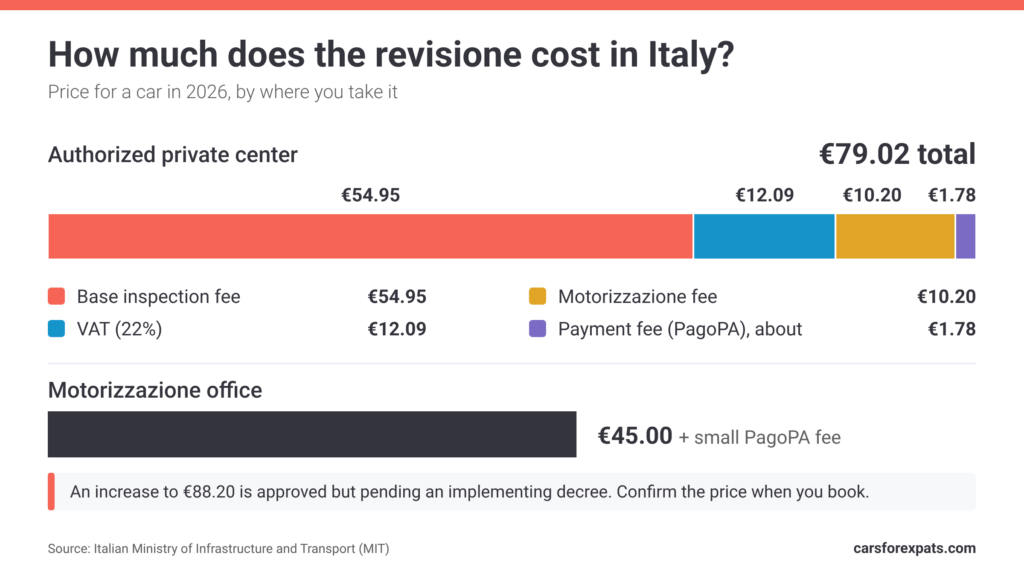
The price is set by the Ministry of Infrastructure and Transport and is the same across Italy. It depends only on where you go.
| Where | Cost | What it includes |
|---|---|---|
| Authorized private center | €79.02 | Base fee €54.95, VAT (22%) €12.09, Motorizzazione fee €10.20 and a payment fee of about €1.78. You pay the center directly. |
| Motorizzazione office | €45.00 plus a small payment fee | Paid in advance through PagoPA (tariff code N046). Booking is required. |
Important caveat on the 2026 price. An increase for private centers from €79.02 to €88.20 has been approved, but it needs an implementing decree from the Ministry, and sources we checked in 2026 reported that the decree had not been published. Some centers may already quote around €88. If one does, ask for an itemized breakdown. Check the Ministry's revisione page again before booking.
These prices cover the inspection itself. Repairs needed to pass are a separate cost, and if you fail, ask the center whether the retest is charged again.
Where to Get It Done: Private Center or Motorizzazione?
Authorized private center
- Faster appointments and more flexible hours
- Payment on the spot, with no advance PagoPA step
- Higher price, at €79.02
- Available for vehicles up to 3.5 tonnes, with a searchable list of authorized centers on the Portale dell'Automobilista
Motorizzazione Civile office
- Lower fee, at €45
- Longer waits and fixed hours
- Booking through the Portale dell'Automobilista, which asks for SPID, CIE or CNS login
- Documents to bring: the application form, an ID, the registration document and the PagoPA payment receipt
For most expats the private center is the practical choice, especially if you do not have SPID yet. The €34 saving at the Motorizzazione is real, but it comes with more steps and more waiting. Do not count on English being spoken at either, so bring your documents in order and know the due date before you arrive.
Step by Step: What Happens on the Day
- Confirm your due date on the registration document or the Portale dell'Automobilista.
- Choose a private center or the Motorizzazione and book an appointment.
- Arrange payment: at the center on the day, or through PagoPA in advance for the Motorizzazione.
- Bring your registration document and an ID.
- The inspector identifies the vehicle and runs the car through the test line.
- The result is entered into the national database and recorded on your registration document.
Pass, Repeat or Suspended: What the Results Mean
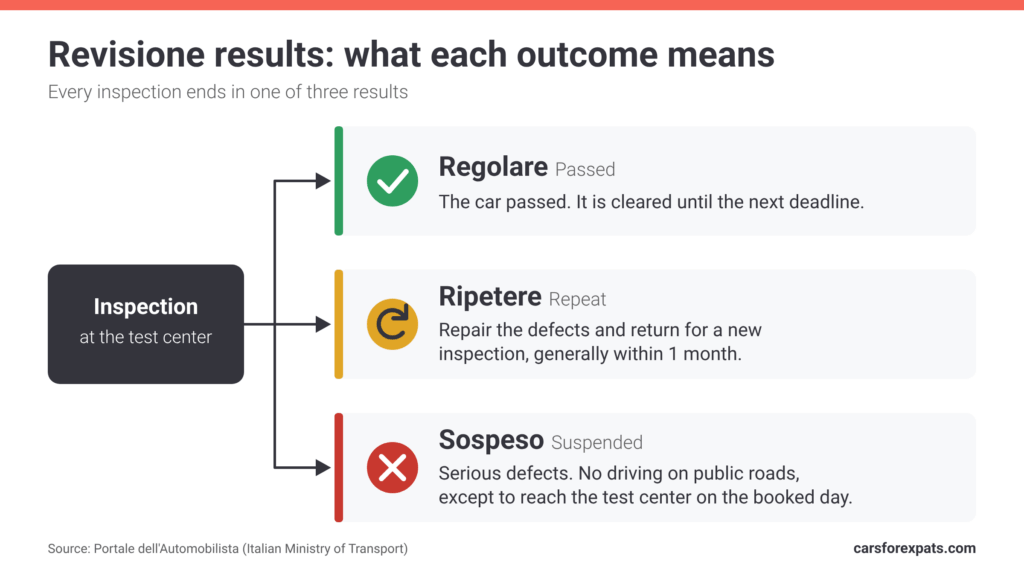
The result is not simply pass or fail. There are three outcomes.
- Regolare (regular): the car passed. It is cleared until the next deadline.
- Ripetere (repeat): the car did not pass. You must repair the defects and return for a new inspection, generally within one month.
- Sospeso (suspended): the defects are serious. The car may not be driven on public roads until it is repaired and passes a new inspection, except to reach the test center on the booked day.
Ask the inspector to explain any defect noted on your result, and keep the repair invoice. You may need to show it when you return.
What Happens If You Skip the Revisione?
Driving with an expired revisione is a violation of article 80 of the Highway Code. The fine currently runs from €173 to €694 and is doubled if the violation is repeated. The vehicle is also marked as suspended from circulation on its registration document until the inspection is done. Driving a suspended vehicle brings much heavier penalties, including a possible vehicle impound.
Enforcement is increasingly based on data. Checks cross-reference the national databases, and an expired inspection can surface during any stop. If you have read our guide to ZTL zones in Italy, you know the pattern: Italian rules are applied automatically, and ignorance of them is not a defense.
A reform of the Highway Code is under way, so check the current amounts if you are reading this later than 2026.
What Expats Often Get Wrong About the Revisione
- Expecting a grace period. There is none. The month ends, and the car is out of compliance.
- Counting from the Italian plate date. For re-registered cars, the original first registration date can matter.
- Confusing the revisione with the service (tagliando). A recent service does not replace the inspection.
- Not checking a used car's inspection history before buying. An expired inspection becomes your problem the day you take the keys.
- Turning up at the Motorizzazione without a booking or a PagoPA receipt.
- Driving to the test with warning lights on. A lit engine or ABS light is a common reason for failure.
- Accepting a price without a breakdown. If a center quotes more than €79.02, ask which items make up the difference.
How to Pass the Inspection First Time
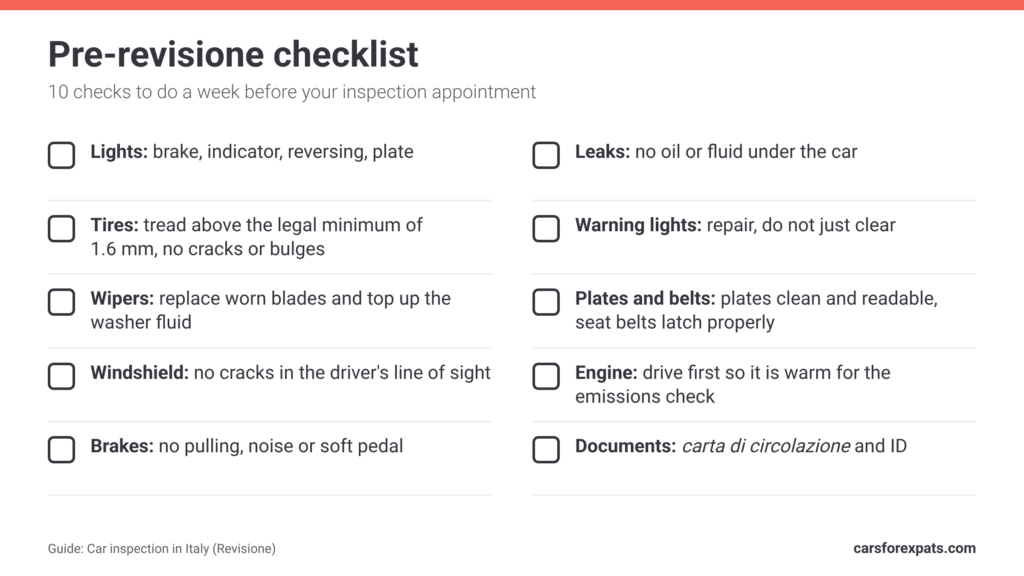
Most failures come from small defects that are cheap to fix before the appointment. A quick check a week ahead is usually enough.
- Test every light, including the brake lights, indicators, reversing light and plate light.
- Check the tire tread (the legal minimum is 1.6 mm) and look for cracks or bulges.
- Replace worn wiper blades and top up the washer fluid.
- Look for cracks in the windshield, especially in the driver's line of sight.
- Repair any warning light on the dashboard. Do not just clear it.
- Make sure the plates are clean and readable and the seat belts latch properly.
- Bring your registration document and ID.
Revisione vs Tagliando: Don't Confuse Them
The tagliando is the manufacturer's routine service: oil, filters and the checks listed in your maintenance schedule. It is not required by law, though skipping it can affect your warranty and the car's reliability. The revisione is the legal inspection and is required by the state.
Having one does not replace the other. A service can reduce the chance of failing, because the mechanic will catch worn brakes, tires or bulbs that the inspector would flag. But the revisione deadline stands regardless.
Buying or Selling a Used Car: Check the Revisione First
Before you buy a used car in Italy, enter its license plate on the Portale dell'Automobilista. The check shows the date and result of the last inspection and the mileage recorded at each inspection since June 2018. That is a quick way to spot a missed deadline or an odometer reading that does not add up.
Our guide on how to buy a car in Italy as an expat covers the other checks that should happen before you pay. If you are selling, a car with a valid revisione is easier to sell, because the buyer has one fewer question to ask.
Revisione in Italy: Quick Summary
| Topic | What to know |
|---|---|
| First inspection | 4 years after first registration |
| Later inspections | Every 2 years |
| Deadline | End of the due month, no grace period |
| Private center cost | €79.02 (an increase to €88.20 is approved but pending) |
| Motorizzazione cost | €45 plus a small PagoPA fee |
| If you fail | Repair and repeat, generally within 1 month |
| If you skip it | Fine of €173 to €694, doubled if repeated, and vehicle suspension |
| How to check | Registration document or the Portale dell'Automobilista, by plate |
FAQ: Car Inspection in Italy for Expats
The first revisione is due 4 years after the car's first registration, then every 2 years. Taxis, chauffeured hire cars and vehicles above 3.5 tonnes are inspected annually.
It costs €79.02 at an authorized private center and €45 plus a payment fee at the Motorizzazione. An increase to €88.20 has been approved but depends on an implementing decree, so confirm the price when you book.
No. The deadline is the end of the due month. After that, the car is out of compliance and you can be fined.
Italian centers generally inspect only vehicles registered in Italy. If you are a resident, the car should be re-registered in Italy, after which the normal schedule applies.
With a "ripetere" result you repair the defects and return for a new inspection, generally within one month. With a "sospeso" result, the car must not be driven on public roads, except to reach the test center on the booked day.
Yes. The Portale dell'Automobilista offers a free inspection check by license plate, with the date and result of the last inspection.
Need Help Keeping Your Car Compliant in Italy?
Deadlines, registration dates and Italian paperwork are easy to manage when you have the right information at the right time. They become a problem when you discover them at a roadside check.
Carsforexpats works with expats in English and Italian, from buying and selling a car to registering a foreign vehicle in Italy. If you are not sure when your inspection is due, or your car's dates do not match across its documents, get in touch before the deadline, not after.
Know the date, book early, and the revisione stays what it should be: a routine errand.